

13 Days
US$

Duration

Trip Difficulty
Easy

Max Altitude
3,800m / 12,467ft

Activity
Motorbike Tour, Sightseeing

Destination
Tibet

Group Size
2-16 People

Accommodation
Hotel, Guest houses stay BB Basis

Meals
Breakfast, Lunch, Dinner

Transportation
Car, Flight & Motorbike
Highlights of Tibet Motorbike Tour From Nepal
- Acclimatization days in Kathmandu with royal cities, temples, and monasteries visit
- Biking across the Tibetan plateau along the Himalayan main ridge
- Permanent escort vehicle with support staff
- Detour to Rongbuk Monastery on the north side of Everest at 5000 m
- Cultural highlights of Gyantse, Shigatse, and Lhasa
- The magnificent mountain world of the Himalayas with Manaslu, Annapurna, Cho Oyu, Lhotse, Everest, Ganesh, Gyachung Kang, Chomo Lonzo, Shishapangma, and Rongbuk glacier
Itinerary of Tibet Motorbike Tour From Nepal
Day 01: Arrive in Kathmandu (1400 m)
Namaskar! The city of Gods, the city of the Himalayas, and the city of culture are honored by your arrival. We are privileged to be your trusted guide for your Tibet motorbike tour from Nepal. We will receive you at TIA Gate and drive you to your comfortable lodging in the city.
Take as much time you like to restore your health after a long exhausting flight. We will stay put for the arrival of all the group members. Till then, you can stroll around and immerse yourself in the evening charm of the city.
Highest Altitude
1400m (Kathmandu)Meals
Breakfast, Lunch, and DinnerAccommodation
HotelDay 02: Visa Application and Day Tour of Kathmandu
Our guide will meet all group members at the hotel in the morning to provide a brief overview of our 13-day Tibet motorbike tour from Nepal. After this briefing, he will accompany you to the Chinese embassy, where you will give your passport, photographs, and fingerprints for authorization.
The embassy will hold your passport until the Chinese Group Visa is granted (3 office days). Now the entire day is free which will be dedicated to visiting Kathmandu.
Pashupatinath, Kathmandu Durbar Square, Swayambhunath, and Boudhanath will be our prime locations today.
Highest Altitude
1400m ( Kathmandu)Meals
Breakfast, Lunch, and DinnerAccommodation
HotelDay 03: Day Tour in Kathmandu Valley
As we await our Visa, we will dedicate another day to sightseeing the amazing wonders of the Kathmandu Valley. Bhaktapur is on our list today which is the former royal city where the temples and houses date back to the Malla dynasty and are decorated with fascinating wood carvings.
After our visit to the ancient town of Bhaktapur, with its Durbar Square and temples, we will take the opportunity to journey to Nagarkot, 12.3 km away.
Behold the magnificent wonders of Manaslu, Ganesh, Everest, and Langtang.
We will now proceed back to Kathmandu, passing the renowned Changu Narayan Temple along the way. This temple is acknowledged as one of the oldest surviving Hindu temples in Nepal, featuring a beautifully carved bronze door.
Highest Altitude
1400m (Kathmandu)Meals
Breakfast, Lunch, and DinnerAccommodation
HotelDay 04: Trip Preparation
Today, we will get our Chinese group visa, which will be collected by a representative from our company. In the meantime, we will take a brief detour to the nearby city of Patan and its Durbar Square.
We will shorten our excursion and return to our hotel to check our bike, gear, and spare parts. It is time to prepare for our adventure along the hilly roads of Nepal on our bike tomorrow.
Highest Altitude
1400m (Kathmandu)Meals
Breakfast, Lunch, and DinnerAccommodation
HotelDay 05: Ride from Kathmandu to Syabrubesi 2380 m, 122 km, 6 to 7 hours
A fine morning to start our exciting Tibet motorbike tour from Kathmandu. Accompanied by our road captain and mechanic, we will mount our bikes and ride towards the mountain hamlet of Syabrubeshi in Rasuwa, near Tibet.
Exiting Kathmandu through Kalanki and Thankot, we will follow the asphalted wide road of Pasang Lhamu Highway, which will guide us to Trishuli and its crowded charming market. A nice place to grab some refreshments for our road.
Continuing onward, we will be greeted by Rani Pauwa and Dhunche, that open up the enormous views of Ganesh, Langtang, Annapurna, and Manaslu. We will now go down into Syabrubeshi, a picturesque lonely hill town inside the enchanting Langtang National Park.
Activity & Duration
6 to 7 hoursHighest Altitude
2380m (Syabrubesi)Meals
Breakfast, Lunch, and DinnerAccommodation
LodgeDay 06: Ride to Gyirong, 2800 m, 40 km, 3 to 4 hours.
A brief ride in the early morning will lead us to Timure and Ghatte Khola. Here, the office of Nepal Immigration will review our paperwork. Then, on along the Sino-Nepal Friendship Highway, we will head to Rasuwagadhi.
Again, our documents will be inspected this time by the Chinese officials. Our Tibetan Guide then welcomes us across the Tibet border who will guide us along our bike ride.
After a two-and-a-half-hour road ride, Gyirong or Kerung town will be reached. Once we have stretched our backs, we can ride out again to the architecturally rich Pakpa Monastery.
After admiring the Princess Bhrikuti statue, we can also ride to the town’s Railway Bridge and stop for a while to view the expansive Kerung Gorge.
Activity & Duration
3 to 4 hoursHighest Altitude
2800m ( Gyirong)Meals
Breakfast, Lunch, and DinnerAccommodation
LodgeDay 07: Ride to Old Tingri, 4300 m, 250 km, 5 hours
We will once again travel the Friendship Highway, where the sweeping plains await us. Our riding adventure will then take us up the majestic 5050 m Lalung Pass. Riding down, we will reach beautiful Nyalam, resting within the striking confines of the Matsang Tsangpo gorge.
Numerous peaceful Gompas and herders of yaks can be seen on the way. Shortly, the raw shepherd’s town of Old Tingri will be reached which in transparent weather opens up the spectacular sights of Gaurishankar, Shishapangma, Langtang, Annapurna, and the grand Everest itself.
Activity & Duration
5 hoursHighest Altitude
4300m (Old Tingri)Meals
Breakfast, Lunch, and DinnerAccommodation
LodgeDay 08: Ride from Old Tingri to Rongbuk Monastery, 5000 m to EBC, 5200 m, 185 km, 7 hours
From Old Tingri, we will ride southeast and eventually overcome the two High Passes of Lamna-La (5150 m) and Gawula Pass/Pang La Pass (5350 m).
The extraordinary masterpieces can be seen from these Passes with the majestic silhouettes of Shishapangma (8027 m), Gyachung Kang,
Cho Oyu (8188 m) , Chomo Lonzo, Makalu (8485 m), Gaurishankar (7181 m),Lhotse (8516 m), Langtang, Everest, and Annaurna.
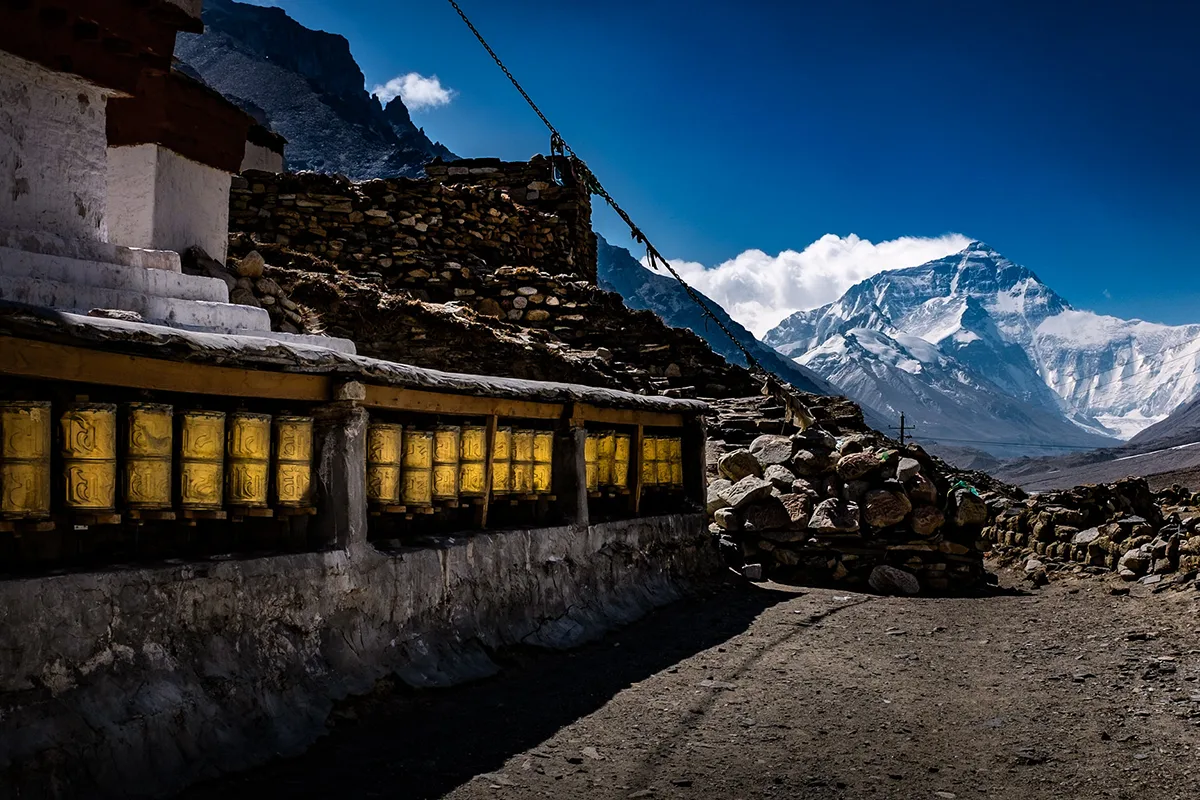
Our journey will eventually conclude at Rongbuk Monastery situated beneath the monstrous Everest. After taking a moment to explore the monastery, we will advance towards EBC. It is just half an hour afar complimented by the amazing views of Rongbuk Glacier.
After our time at EBC, we will retreat to the monastery guesthouse to spend the night.
Attention
In January 2019, the Tibet Government decided to shift the Everest Base Camp to a new spot 1.5 kilometers before its original location, close to Rongbuk Monastery. Now, only climbers with the appropriate permits can visit the actual Everest Base Camp. This move has been in action to clean the extensive litter that has gathered over time.
Additionally, we will not be permitted to ride our bikes within a 4 km radius of Rongbuk Monastery. Instead, we will have to board the electric bus, which operates every 30 minutes.
Activity & Duration
7 hoursHighest Altitude
5200m (Rongbuk Monastery)Meals
Breakfast, Lunch, and DinnerAccommodation
LodgeDay 09: Ride to Shigatse,3845 m, 340 km, 5 to 6 hours
Rise with the early morning sun to witness the initial rays of light over Everest that create a scene that feels almost magical.
We will now ride one again towards Tingri from where a consistent climbing road will lead us to Lhatse. Crossing the 5220 m Gyatso La/Lhakpa La Pass, the road now takes us to Shigatse.
Here, we will be visiting the Tashilunpo Monastery, which was founded in 1447 by Genden Drup, the first Dalai Lama. Later, it turned into the the official administrative seat of the Panchen Lamas.
It houses the assembly hall, the chapels and tomb stupas of the fourth and the 5th to 9th Panchen Lamas, the golden tomb stupa of the 10th Panchen Lama, the Kelsang Temple, and the Durbars (palaces) of Panchen Lamas.
Activity & Duration
5 to 6 hoursHighest Altitude
3845m ( Shigatse)Meals
Breakfast, Lunch, and DinnerAccommodation
HotelDay 10: Ride from Shigatse to Lhasa, 3650 m via Gyantse, 3950 m, 280 km, 6 to 7 hours
With our bikes riding through the air, we will be in Gyantse in a few hours. First, the road winds upward to the Karo La Pass (5010 m) with the majestic sight of 7206 m high Nozin Khangsa.
Soon, the picturesque Yamdrok Tso Lake, located 100 kilometers southwest of Lhasa will come into our view. It is honored as one of Tibet’s three holiest lakes.
A small stopover at Gyantse will allow us to visit Palkhor Chode Monastery with the large, multi-story Khumbum Stupa, unique in the world. It was founded in 1418 and was once a multinational monastery complex.
The four protector statues stand at the entrance, and Sakyamuni sits enthroned in the rear chapel. On the upper floor, there are also interesting temple halls with Indian and Nepalese relics.
The most beautiful, however, is the world-famous, nine-story, 32 m high Khumbum Chorten or Stupa, which was commissioned by a prince from Gyantse in 1440.
It is covered by a golden crown, and the Nepalese eyes of Buddha can be seen on all four sides of the accessible platform. It was built by Nepalese carpenters, and the influence of the Newari and other Nepalese artists is also clearly visible inside.
We will ride once again through the captivating path beside Yamdrok Lake for a few hours. Our adventure will reach its peak at 4794 m Khamba La, as we approach the historic capital of Lhasa.
Activity & Duration
6 to 7 hoursHighest Altitude
3950m ( Lhasa)Meals
Breakfast, Lunch, and DinnerAccommodation
HotelDay 11: Lhasa Tour: Potala Palace, Jokhang Temple and Barkhor Market
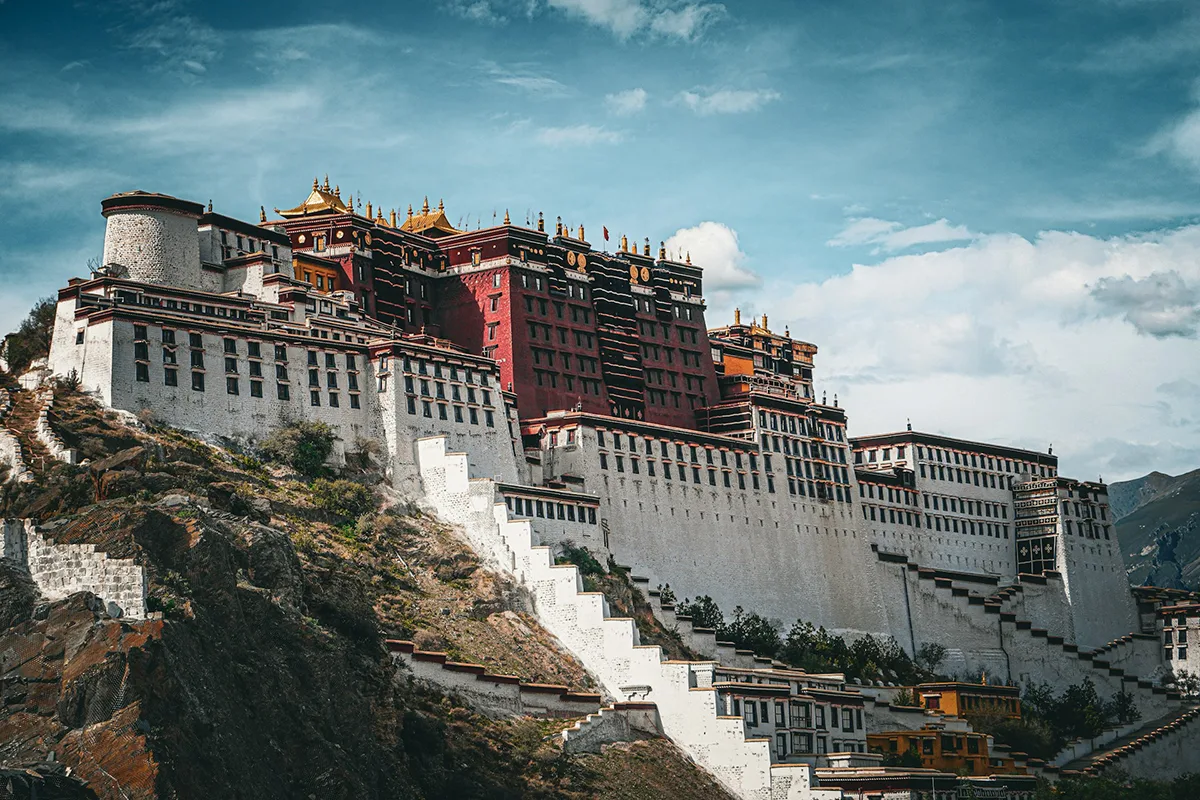
Today, we will engage in a short bike ride to Lhasa for acclimatization. We have planned a Potala palace visit in the morning, an architectural masterpiece originally built in 637 by Songtsen Gampo, the first king of a unified Tibet.
This building was later transformed into the winter lodging of the Dalai Lamas, it then became the political and religious center of traditional Tibet.
The large number of pilgrims, along with the beautiful murals, Buddhist statues, scriptures, and rare artifacts, collectively create an impressive environment lasting on all who visit.
In the afternoon, our travel plan includes a trip to Jokhang Monastery, recognized as the prime point of Tibetan Buddhism. It is also a sacred destination for numerous devotees who come to worship daily.
Established in 647, this temple is the oldest surviving wooden temple in Tibet. A walk along Barkhor Street, which surrounds Jokhang, will also reveal a bustling marketplace filled with stalls that offer local delicacies.
Highest Altitude
3656m (Lhasa)Meals
Breakfast, Lunch, and DinnerAccommodation
HotelDay 12: Roll in tour in Lhasa: Drepung Monastery, Sera Monastery
We will take a morning tour of the Drepung Monastery- the largest Gompa that existed. At one time, it sheltered ten thousand monks and served as the sacred abode of the Dalai Lama before the Potala Palace.
Here, we can wander through the narrow, bending alleys of the monks’ quarters, and the ancient corridors of the monastery, discover a peaceful courtyard, and gain a glimpse into the daily lives of the monks.
The afternoon will see us taking a trip to Sera Monastery, constructed in 1419. This monastery has been serving as a significant center for Buddhist learning and stands as one of the six major monasteries of the Gelugpa tradition.
As the lush roses bloom across its grounds, it is fondly called the Court of Wild Roses. Currently, about 200 lamas call this monastery home, offering visitors an incredible opportunity to observe the Buddhist scripture debates among the monks.
Highest Altitude
3656m (Lhasa)Meals
Breakfast, Lunch, and DinnerAccommodation
HotelDay 13: Lhasa exit
Our exciting Tibet motorbike tour from Nepal has reached its end. Our Tibetan guide take you either to the airport or train station from where you will go to your home.
You can also continue your bike-riding adventure trip in Nepal so why not take a flight to Kathmandu instead?
Meals
BreakfastEssential Information of Tibet Motorbike Tour From Nepal
Why should I bike ride from Kathmandu to Lhasa?
Riding a motorcycle from Kathmandu to Lhasa along the stunning Sino-Nepal Highway allows you to travel at a relaxed pace, and explore hidden Tibetan villages and monasteries that are often overlooked by typical organized tours.
You will have complete control over your travel program, allowing you to take a break whenever and for as long as you desire. Additionally, you will come to know about your own limits as you make your way to Rongbuk.
You will have complete freedom that allows for a deep and personal exploration of Lhasa, so you can know the city at your own pace.
Safety during Tibet motorbike tour from Nepal
Our Tibet motorbike tour is far more safe than you think. Since you will be traveling to Tibet on an organized tour, you will be accompanied by both a Nepali and a local Tibetan guide, along with a support team until your journey ends.
Plus, our support team will follow you with the truck so you can take a break from riding whenever you feel exhausted. They also come with the supplies of medical kit, oxygen cylinders, basic bike spare parts, helmets, water, and repair tools so your road trip can be smooth.
The roads in Tibet are also well-maintained and wide with light traffic. However, some sections in Nepal and from Old Tingri to the Everest Base Camp require your careful attention. After EBC, the roads are wide and asphalted so you don’t have to stress at all.
Should I bring my personal bike or rent one for your tour?
If you possess our own quality and well-maintained bike and if you are used to riding only your personal bike, then yes, you can bring it on our Tibet motorbike tour from Nepal. This way, you will have a sense of comfort, confidence, and familiarity throughout the journey.
However, bringing the bike from your country and customs clearance can be a headache. In such a case, you can use the bike we provide on our Tibet motorbike tour.
We will supply you with five Royal Enfield 500 CC bikes, along with one bike for the Road Captain, and fuel will be covered for the journey from Kathmandu to Lhasa.
Please keep in mind that a deposit of USD 500 per bike is required, and you will be responsible for any damages to the bike due to unforeseen circumstances or loss of bike equipment. Additionally, an international bike riding license is required for this trip.
Attention
If you are bringing your personal bike, we suggest you give us the details of your bike so that we can check if you can find adequate technical assistance in Nepal and Tibet.
Weather And Best Season
The weather in Nepal is tropical in nature affected by the monsoon rain. On our Tibet motorbike tour from Nepal, most of your time will be spent in Kathmandu, so you can expect delightful weather except during the monsoon months of June to August when heavy downpours occur.
In Tibet, the climate is bright, windy, and deserty for most part of the year. It’s a little varied in the Everest region though. Lhasa and Shigatse are dry almost all year receiving only minimal precipitation even in the monsoon season of June through August.
On the other hand, the Everest region is thoroughly wet precipitating between 94 and 108 mm. In winter, the day heat can often drop to 7 degrees Celsius, with night heat between -12 and -17 degrees Celsius.
Therefore, considering the weather patterns both in Nepal and Tibet, the best window for our Tibet motorbike tour is from the last days of September to the initial days of June.
September through October influenced by the autumn season often makes the bike trip on the road pleasant with comfortable heat between 19 and 20 degrees Celsius.
On the other hand, the spring-affected months of March through May are also excellent choices, with warmer days that can reach 25 degrees Celsius with high oxygen concentrations in the Tibetan air.
Trip Difficulty
Our Tibet motorbike tour from Nepal is a medium-difficult tour, suitable for anyone who has a good spirit of adaptation and a love for biking. The road usually involves moving along well-maintained roads in Tibet (except for EBC). However in Nepal, over 100 km from the border are dirt roads but without technical difficulties.
Yet, you must ride along a winding road that twists and turns uphill and downhill, so you must have a good bike riding skill. Additionally, Tibet features a diverse range of terrains; at times, you will traverse flat trails, and at other times, you will climb over passes that rise above 5,000 m.
On the other hand, the actual daily stages have an indicative average duration of 5-6 hours with peaks of 7 or more hours for some stages. Therefore, a good level of training is required for those who ride a bike.
But the real challenge lies in the sudden altitude change. The entire Tibet motorbike tour takes place mainly between 3600 and a good 5000 meters. After leaving Kathmandu, it climbs up over 4000 m in altitude above sea level in Tibet.
Our guide will consider this factor and make certain that you adjust properly before ascending to higher locations.
Altitude Sickness and Acclimatization
In our Tibet motorbike tour, the high altitudes will be experienced only in Tibet as in Nepal, Kathmandu, and Syabrubeshi altitudes don’t exceed 2500 m. plus, the Tibetan air has also lower oxygen concentration which has already been studied.
Over the next three to four days, you will journey to Everest Base Camp and Rongbuk, reaching an altitude of 5,000 meters. When moving from the low grounds to high within a few days can trigger the condition of altitude sickness.
Remember, this condition is nowhere related to your age or fitness which means anyone can find themselves affected by this condition. It mainly develops when you exert yourself excessively during the journey.
You have to relax and take things gradually; it’s not a bike race, it’s a serene journey to seek your soul. That’s why, we have taken a gradual approach to our journey, with nearly a full day for acclimatization in Gyirong town before advancing to the Everest Base Camp.
Plus, in Lhasa, you will have two days for touring the city. Yet, some of you may go through headaches, insomnia, reduced appetite, and shortness of breath. These symptoms of altitude sickness generally resolve in a short period.
We request you to reach out to our support team before your issue worsens. You can consider taking Diamox before you enter Tibet so your adapting process can speed up.
Our support team carries portable oxygen cylinders for emergencies, but we request you not to use them for minor discomfort. Frequent use can lessen their effectiveness when you most need them at EBC.
It is always better to prevent issues than to treat them, so we encourage you to hydrate well and avoid sleeping pills, smoking, and alcohol.
Trip Preparation, Health, and Safety
Bike riding may seem to be an easy journey but in reality, tackling an adventure in a bike without the right preparation increases the risk of incurring injuries and risks.
In our Tibet motorbike tour from Nepal, you have to travel on your bike for maybe 50 to 70 km a day. It requires a strong determination but above all good physical resistance, especially when you are a beginner.
Therefore, good planning and training are needed that will allow you to tackle easily the most difficult points of the route. Such as the uphill ones for example, or the long rides on the flat.
The first step to take to prepare for a bike trip is to start spending as much time as possible on your ride. It is important to start gradually, for example by planning two or three weekly outings on flat routes and then gradually increase the mileage.
Also, dedicate your training to building up muscle strength preferring uphill routes. Carry out the slope repeatedly for at least 40 minutes and try to ride on different characterized terrain and altitudes.
Also do not forget to stretch and rest after each of your excursions which allows you to develop flexibility and helps prevent injuries, as well as allowing you to maintain good elasticity, which is essential for tackling every outing to the best of your ability.
A daily stretching session of at least 20 minutes is advisable, accompanied by correct breathing. And, don’t forget to dedicate the right space to relaxation and hours of sleep, also taking care to maintain a well-balanced diet.
Accommodation, Food and Drink
During the entire period of our Tibet motorbike tour, we will ensure you stay in the best quality lodging available both in Nepal and Tibet. In Kathmandu, Shigatse, and Lhasa, you will live in good tourist standard hotels with double bedrooms with your own bathroom with hot showers.
However, in Syabrubeshi, Gyirong, Old Tingri, and Rongbuk, the accommodations will be relatively basic. In the top season, it may be necessary to stay under tents in the monastic grounds of Rongbuk.
However, we will make sure each lodging has enough oxygen supplies and an effective heating system.
In terms of food, three times meals excluding beverages will be served beginning from Kathmandu. In Gyirong, there are choices between Tibetan, Chinese, Indian, and Nepali cuisine.
However, from Old Tingri up to Ronbuk, you have to be satisfied with the limited Tibetan cuisine of soup, noodles, bread, and eggs.
From Shigatse onward, the food choices will be wide with Western alternatives. There are numerous bars and pubs where you can taste wide variations of drinks.
Transportation, Communication, and Internet
For transportation in our Tibet motorbike tour, we will supply five Royal Enfield 500 CC motorcycles for your travel from Kathmandu to Lhasa. You need to make deposit of US$ 500 for each motorcycle. Fuel for the entire journey will be provided, along with basic spare parts and helmets.
A support truck will follow you throughout the journey, allowing you to rest whenever you feel tired. Please remember that you will have to bear the costs incurred due to damage to the bike resulting from your negligence.
In Kathmandu, our private vehicle will facilitate your travel for the Visa formalities and tours around the city.
You will have reliable communication and internet access in both Nepal and Tibet. In Kathmandu, you can utilize physical SIM cards from the Namaste and Ncell networks, or opt for their eSIMs.
In Tibet, our Tibetan guide will facilitate the obtainment of SIM cards from local Chinese providers. The availability of 5G service has now reached everywhere in Tibet including Rongbuk and the Everest Base Camp.
Wi-Fi will be accessible in various locations in Lhasa and Shigatse, including hotels, restaurants, shops, and bars. It is important to store a VPN to use social media applications, as they are prohibited in China.
Travel Insurance
Travel insurance is an important component when going on a Tibet motorbike tour from Nepal. After all, injuries occurred during biking can be severe and require costly hospital care. Additionally, any damage to the bike will come from your own pocket.
Therefore, purchase travel insurance that will not only cover the medical expenses in the event of an accident and evacuation but also the cost of losing or damaging your bike.
Your travel insurance should also guarantee civil liability for mobility, mobility injuries, mobility assistance, and legal protection for mobility, compensating for damages involuntarily caused to third parties while driving the vehicle.
So before purchasing insurance, it is advisable to clarify the details of the trip with an insurance company specialist.
Visa, and Permits for Tibet motorbike tour from Nepal
To go to Tibet on any type of tour, you must have special permits from the Ministry of Tourism in Tibet and you must be part of a group of minimum 4 travelers. And, for a Tibet motorbike tour, you must posses an international driving license.
If you lack any of these components, you will not be able to check into hotels, you won’t be allowed to ride on Tibetan roads. Our bike trip involves a visit to EBC in Shigatse, which is a specially protected region of Tibet.
So just like for the Kailash tour, our trip also requires a Chinese Group Visa, TTP (Tibet Travel Permit), Foreign Affairs Permit, Alien’s Travel Permit, and Military permit.
We cordially ask you to approach us at least a month before your trip. Please read carefully our itinerary and inform us if you like any modifications. Once it is confirmed, no alterations whatsoever are allowed after the permit application.
For the permit application, we need you to send us:
Passport color scanned copy with residual validity of more than 6 months with 2 free pages with no cutouts
51 by 51 mm photo, with no spectacles, no makeup, white background
- TTP – Tibet Travel Permit
Tibet Travel Permit is a mandatory travel document that must be obtained before your entry into the autonomous region of Tibet. This permit allows you to visit Tibet and is authorized by the Tibet Tourism Development Committee in Lhasa.
It cannot be obtained elsewhere, including Chinese embassies or authorities in other parts of the world. You can only get it through a travel agency authorized by the Chinese government and that agency will have a limited time to send it to you.
First, we will send all the details to our partner in Tibet (Tibet travel agency) about our Tibet motorbike tour from Nepal with information about each group member with all their documents.
We will then receive an invitation where it will also be mentioned that a certified Tibetan guide will follow us on the tour and that they will take responsibility for obtaining the special permit to enter Tibet.
All that is left for us is to wait for the arrival of all our participants. Meanwhile, our concerned guide in Tibet will acquire TTP and show it to officials at Gyirong.
- Chinese Group Visa
Once everyone has arrived in Kathmandu, we will proceed to the Chinese Embassy the next day to submit your passports, photographs, and fingerprints for biometric identification.
The embassy will retain your passport for three business days, returning it to us once your visa is ready, which we will pick up for you. This Visa is one collective document for all participants, so a group entry and departure is a must.
- Foreign affairs permit
The Tibet Foreign Affairs Office is the only one responsible for issuing this permit. We will forward copies of your passport and Group visa to our Tibetan Guide. Once he obtains your TTP, he will submit all these documents to the relevant office, which will process the permit within 10 to 15 working days.
- Aline’s Travel Permit
Along with our Tibetan guide, we will go to the Tibetan Local Public Security Bureau and present our documents. The permit will be on our hands within few hours.
- Military Permit
After our Tibetan guide has your documents and TTP in hand, he will take them to the military office for processing. The permit should be ready for you within 10 to 15 days.
Frequently Asked Question (FAQ’s)
Yes and No, Tibet is indeed home to the Himalayas, the highest mountains on the planet. Their peak, Chomolungma, is 8,848 meters high. At the same time, Tibet has not only mountains, but also fertile valleys, deserts, rivers, and lakes.
Tibet is indeed a safe destination for bike trips. There are numerous checkpoints located approximately every 50 kilometers, and our Tibetan guide along with a support team will provide support throughout our Tibet motorbike tour from Nepal. While altitude may present some challenges, our guide will ensure your well-being. We suggest you refrain from mentioning the name of the Dalai Lama, carrying any related posters, or calling FREEDOM FOR TIBET.
Yes, you can begin from Lhasa, then journey through Shigatse to EBC, and later enter Nepal at the Gyirong border.
The road conditions in Nepal and Tibet are quite diverse. Although they are asphalted, riders will face both uphill and downhill sections, resulting in a prolonged trip. If you want to ride a bike by yourself, it is advisable to have some past experience. However, for beginners, we will have a rider accompanying you all the time.
Trip Reviews on Tibet Motorbike Tour From Nepal
