


10 Days
US$

Duration

Trip Difficulty
Easy

Max Altitude
4,773m / 15,659ft

Activity
Trekking

Destination
Nepal

Group Size
2-16 People

Accommodation
3 star hotel, Lodge

Meals
Breakfast, Lunch, Dinner

Transportation
Car & Flight
Highlights of Langtang Valley Trek
- A scenic mountain journey to Syabrubeshi near the Tibet border
- Kyanjin Gompa Surroundings and Monasteries
- To the top of Tsergo Ri
- A Himalayan paradise of Langtang Himalayas, Naya Kanga, Gangchempo, Dorje Lakpa, Ganesh and more
- Langtang, its park, its forests and its langurs, Himalayan Thars, red panda, snow leopard, and many more
- A blend of Sherpas and Tamang communities, their culture and beliefs
- A family-friendly trek
Itinerary of Langtang Valley Trek
Day 01: Kathmandu (1350 m) Landing and hotel transfer, trip briefing
Nepal is delighted by your arrival and we are truly honored that you have selected us for your extraordinary Langtang Valley trek. our delegate will stand by at TIA till you exit its gate and drive you through the loving streets of the city to your comfortable lodging.
After some relaxation, you can tour the enchanting nooks of the city at your time. Once all our group members arrive, our tour guide will conduct a small informative briefing on the Langtang trekking program.
we suggest you try out Nepali specialties in one of the restaurants nearby or at the hotel. Please end your evening early as we will have a long road journey tomorrow.
Highest Altitude
1350m (Kathmandu)Meals
Breakfast, Lunch, DinnerAccommodation
Three-star HotelDay 02: Kathmandu to Syabrubeshi (1503 m) drive - 7 to 9 hours.
Our day begins with a thrilling drive towards the mountains into the lonely yet beautiful small village of Syabrubeshi. As we move out of the urban location of Kathmandu, we will pass Kalanki and Thankot.
Then, the vast asphalted Highway of Trishuli extends up to the Trishuli market where a short break for lunch awaits us. Now, another expansive Highway named after the remarkable female Everest Climber Pasang Lhamu will take us forward toward Rani Pauwa. Dhunche- the administrative center of Rasuwa.
Here the Nepal Army checkpoint will review our documents and allow us to enter the secured zone of Langtang National Park. Then we will proceed to New Syabrubeshi, which peacefully overlooks the massive Bhote Koshi River.
Our drive will progress further over the long strong bridge towards old Syabrubeshi- a genuine peaceful town encircled by Annapurna, Ganesh, Langtang, and Manaslu.
Activity & Duration
7 to 9 hoursHighest Altitude
1503m (Syabrubeshi)Meals
Breakfast, Lunch, DinnerAccommodation
LodgeDay 03: Hike to Lama Hotel (2,500 m) – 5/6 hours.
Today, we begin our walking section of our Langtang trekking so it is worth taking a moment for some warm-up and stretches. We will now
walk across the two thrilling steel bridges swaying over the Bhote Koshi River.
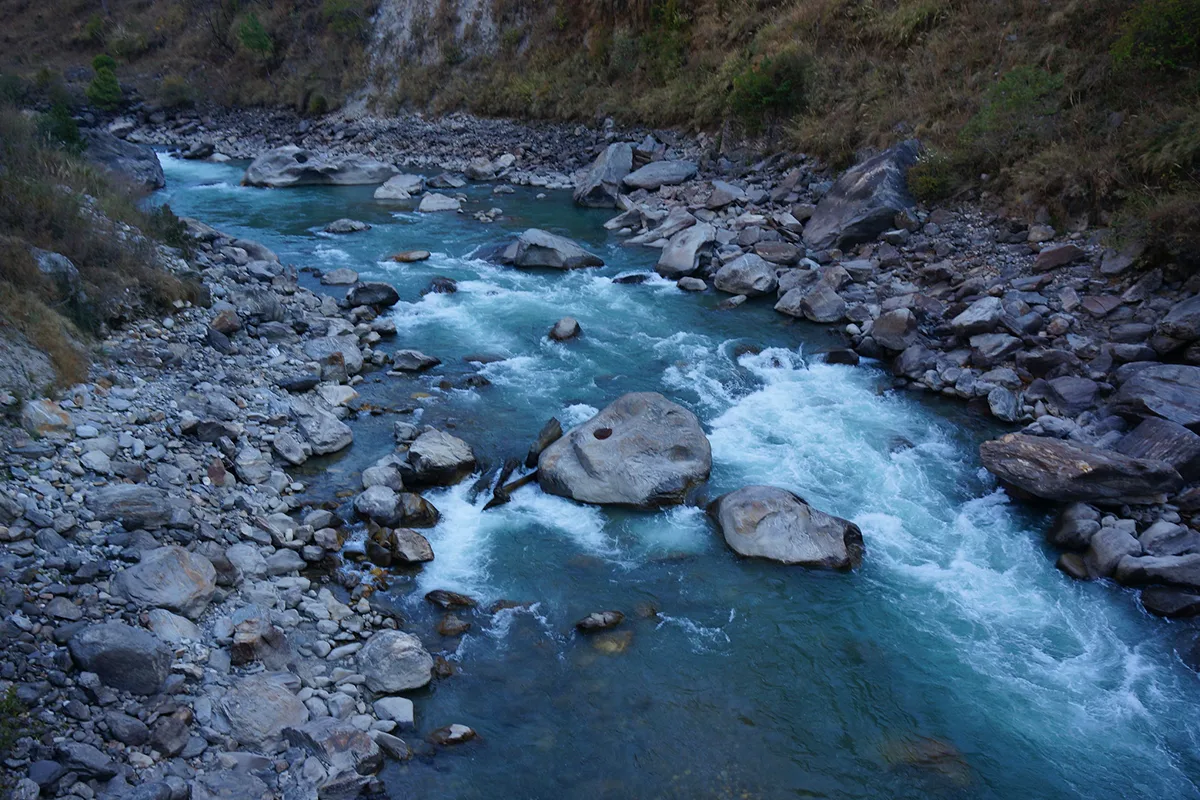
Now, leaving behind Bhote Koshi, the Langtang Khola will join us revealing its beauty time and again flowing through the gorges. Soon, we will reach the endearing 1620 m high Dhomen Village hinting we are in the exquisite Langtang region
The shadowy lush jungle of rhododendrons and conifer will take us under its shelter taking us to the inviting Bamboo lodge. From here on, we will journey upward for two more hours along the long vertical stone steps.
Soon, we will be welcomed by the charming town of Rimche. Lama Hotel is not far now, soon we will be able to rest our feet in its comfortable lodging.
Activity & Duration
5/6 hoursHighest Altitude
2500m (Lama Hotel)Meals
Breakfast, Lunch, DinnerAccommodation
LodgeDay 04: Hike to Mundu (3543 m), 6/7 hours
The Langtang Khola will keep on playing with us as we walk through the profuse forest of Langtang towards the Nepal Army checkpoint of Ghumanchowk.
Next, our journey will move on through the tall crimson-colored Laligurans (rhododendrons) towards Chunama. A little break will give us the alluring glimpses of 7225 m Langtang Lirung.
Now our trail will rigorously climb through the juniper trees, and delicate irises, to 3000 m Ghora Tabela (Horse Stable). the track will now gently drop below leading us to Thangshyap, Ghumba, and Chyamki to Langtang.
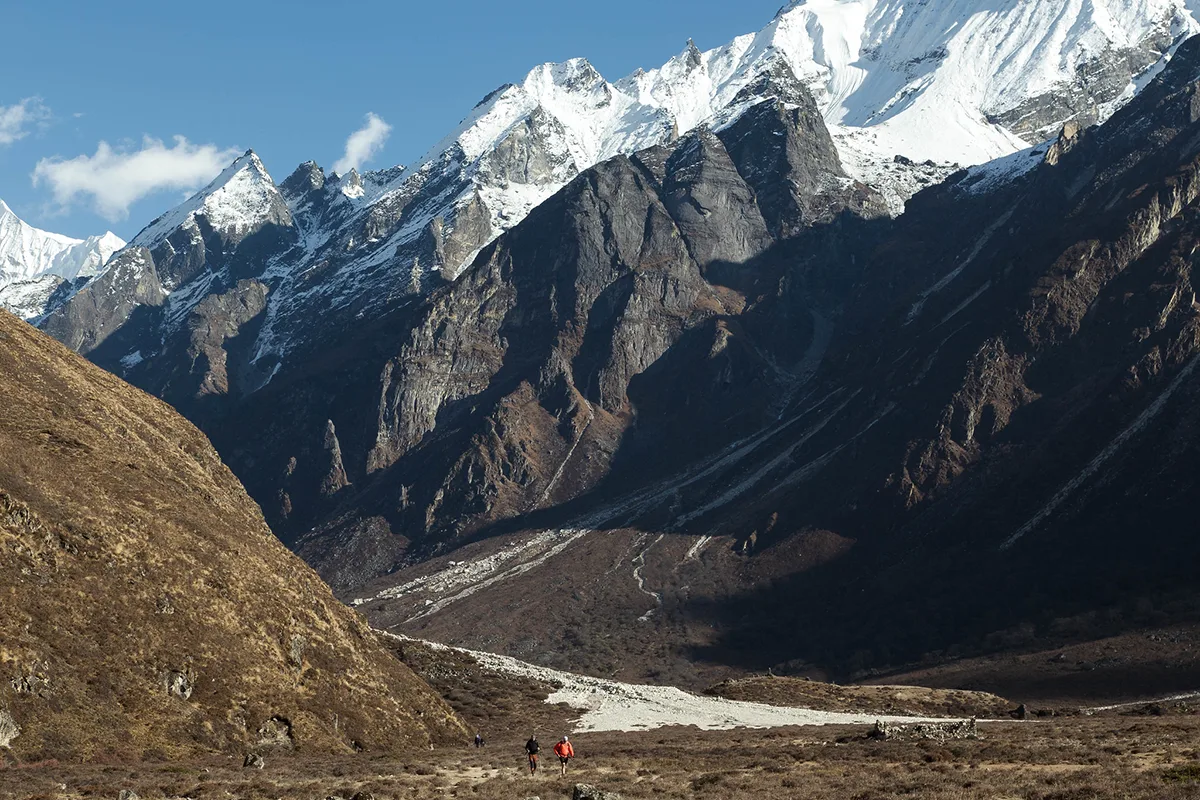
On these lonely roads, Dorje Lakpa, Ganesh, Naya Kanga, and Langtang Lirung will be our true allies as we climb towards Mundu- the new Langtang Village after the catastrophic effects of the 2015 earthquake.
Activity & Duration
6/7 hoursHighest Altitude
3543m (Mundu)Meals
Breakfast, Lunch, DinnerAccommodation
LodgeDay 05: Hike to Kyanjin Gompa (3,830 m) – 3/4 hours.
One of the most beautiful stages, where we will leave the humid and green forests to enter the typical Tibetan plateaus, large spaces devoid of vegetation.
From Mundu, the track little by little climbs through the yak pastures of Singdun and Yemphu. Now the Langtang Valley opens up further and the views become wider.
Kyanjin Gompa will shine nearby with the white endearing peaks of Langshisha Ri, Dorje Lakpa, Langtang Lirung, Chorakri Ri, Kinsung, Kyanjin Ri, and Gangchempo.
Kyanjin Gompa is without a doubt a beautiful stop where there is a small monastery and a dairy farm.
Activity & Duration
3/4 hoursHighest Altitude
3830m (Kyanjin Gompa)Meals
Breakfast, Lunch, DinnerAccommodation
LodgeDay 06: Trek to Tsergo Ri (5033 m) and back to Kyanjin Gompa
Today we have a rest day at Kyanjin Gompa with excursions in the surrounding area. Those who appreciate conventional mountain tourism can move forward to ascend the 5033 m high mystical peak of Tsergo Ri.
No equipment is needed to be carried, you can simply move east towards the formidable cliff of Langshisha Kharka. Afterward, you will engage in an arduous climb to Yala Kharka and a short upward journey over the rugged trail will lead you to the peak of the Tsergo Ri.
Gangchempo, Naya Khang, Yala, Langtang Ri, and Langtang Lirung emerge beautifully here. After our experience in the mountains, we will now go back to the lively settlement of Kyanjin Gompa and join locals and enjoy their light conversations over a cup of tea.
Highest Altitude
5033m (Tsergo Ri)Meals
Breakfast, Lunch, DinnerAccommodation
LodgeDay 07: Hike Back to Lama Hotel (2,500 m) – 5/6 hours.
From Kyanjin, we retrace our route along the Langtang Khola to the Lama Hotel in about 5 to 6 hours of walking. Taking our time, we make our way down through the well-known hamlets of Mundu, Ghumba, Thangshyap, Ghoratabela, and Ghumanchok, before finally settling in at the Lama Hotel.
Activity & Duration
5/6 hoursHighest Altitude
2500m (Lama Hote)Meals
Breakfast, Lunch, DinnerAccommodation
LodgeDay 08: Trek to Syabrubeshi (1,503 m) – 5/6 hours.
Today is our final walking day from Lama Hotel to Syabrubeshi in about 5-6 hours. The upper part of the route is scenic because this route is wider and stays sunny crossing several Sherpa and Tamang villages.
Rimche and Pairo will be crossed first then Langtang Khola will leave us as we retrace over the tall long hanging bridges towards Bhote Koshi Valley. Syabrubeshi is ready to once again welcome us in its warm embrace.
Activity & Duration
5/6 hoursHighest Altitude
1503m (Syabrubeshi)Meals
Breakfast, Lunch, DinnerAccommodation
LodgeDay 09: Drive Back to Kathmandu– 7/9 hours.
In the early morning hours, we will once again drive along the serpentine hills back to the capital. As we journey back, Dhunche, Rani Pauwa, and Trishuli Bazaar seem to be more sad by our departure than us.
Gradually, the urban life of Kathmandu begins to show its glimpses as we approach Thankot and Kalanki. Finally, within the comfortable setting of our lodging, we will relax and gather in the evening with our remarkable team for a lively farewell dinner.
Activity & Duration
7/9 hoursHighest Altitude
1400m ( Kathmandu)Meals
Breakfast, Lunch, DinnerAccommodation
Three-star HotelDay 10: Final Departure
As your enchanting stay in Kathmandu draws to a close, you can seize this opportunity for some trinket shopping for your family and friends. Our team will come with you to TIA and bid a heartfelt farewell. See you my friends in the next exquisite adventure in Nepal.
Meals
BreakfastEssential Information of Langtang Valley Trek
What is the nature of climate condition in Langtang Valley?
Langtang Valley is home to numerous endearing small settlements protected under the roof of verdant forests. There are also some villages that are more open in the air rising to the sky such as Kyanjin Gompa where the raw and authentic influence of Tibetan climate can be felt.
However, it still thrives under the temperate subtropical climate, shaped by the monsoon rains. The thermometer often scales up to 28°C during the summer of June while it scales down to 16°C in the winter chills of January.
The entire year in Langtang enjoys a comfortable temperature of around 18.5°C while the annual rainfall may occur up to 555.9 mm.
January is likely to be the month time when the region is mostly under the baking sun. While August wets the region rigorously with up to 123.7 mm of rain.
When to visit Langtang Valley?
The prime season for the Langtang trekking is definitely autumn but the other seasons are not that bad either. October and November are the best months to travel to Langtang Valley; however, it also means greater affluence, with tourism tending to decrease towards the end of November.
The tendency is for clear mornings and probable cloud cover in the afternoon. The visibility of the mountains is at its best, it rarely rains and the temperatures, pleasant during the day, remain tolerable even during the night.
Spring( the period between March to May) is also a very popular season for the Langtang Valley trek. In this period the blooming of rhododendrons is something magnificent, an explosion of colors that gives warmth and vitality to the landscape. You will comprehend ahy Laligurans has been selected the national flower of Nepal.
The monsoon (period between June to August) is perhaps the worst in terms of visibility. The paths at this time of year are covered in mud and slippery, there is a high risk of landslides and to keep you company along the paths there will be the dear friends leeches waiting for you.
Winter (period from December to February) wouldn’t be such a bad season in terms of visibility. The Langtang trek is at a lower altitude, so it is possible but you will definitely need to cover up well.
Langtang Valley Trek Terrain and Length
The Langtang trekking, although lasts only ten days, will lead you through a diverse ecosystem, transitioning from the thriving rhododendron forests to the tall bamboo and conifer landscapes.
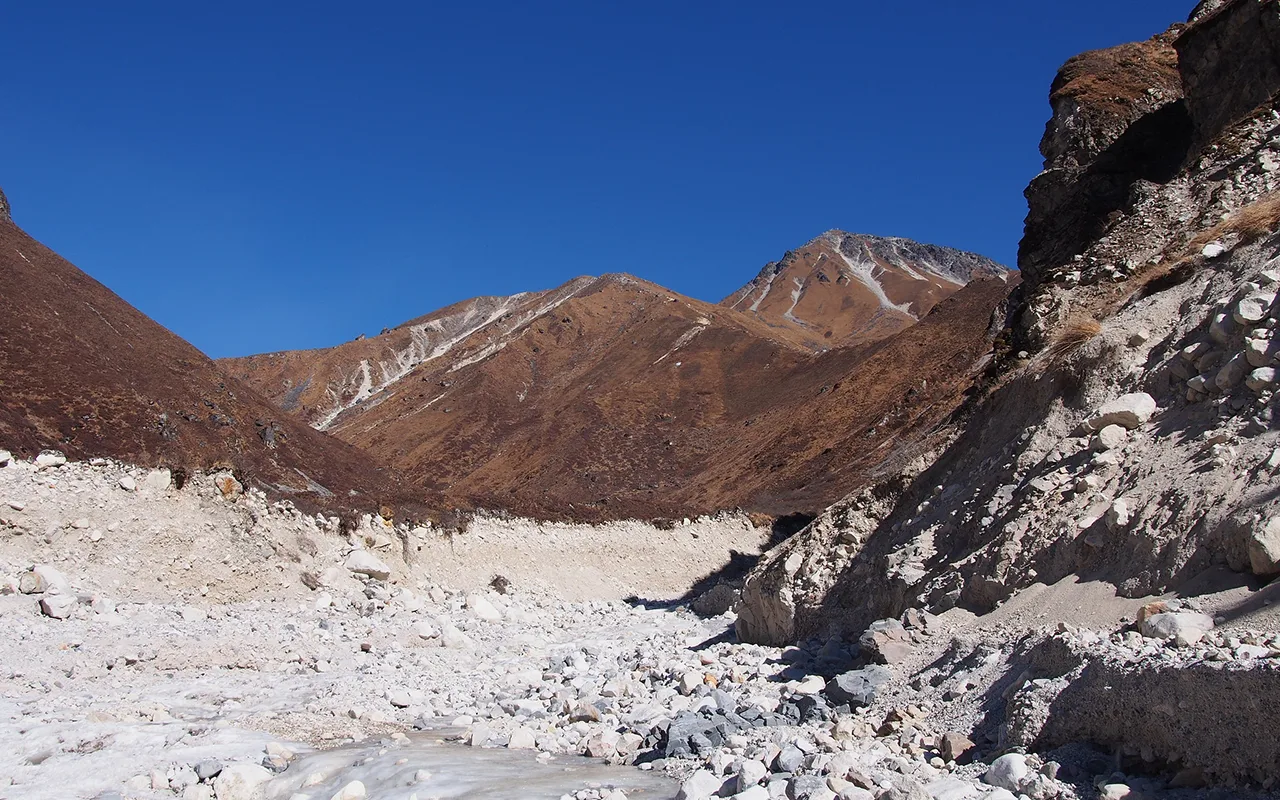
There are also long powerful rivers of Bhote Koshi and Langtang Khola while there are also highlands of Kyanjin Gompa soaring to the sky. There is also an icy ridge of Tsergo Ri where you will be encircled by the sounding icy rocks of Langtang Himals mainly.
Although variant in nature, the Langtang Valley trek is a circuitous path covering just 61.8 km from Kathmandu.
This brief but grand adventure begins in the old-fashioned town of Syabrubeshi, 122 km from the heart of Kathmandu. Around 61 km separates Syabrubeshi from the delightful Langtang Village.
The modest settlement of Kyanjin Gompa will be our highest sleeping height where we often feel we are literally touching the sky with our fingers. Tsergo Ri on the other hand with its 5033 m altitude will symbolize the highest elevation gain in our Langtang Valley trek.
The daily distances we traverse are comfortably manageable within 10 to 12 kilometers.
Difficulty level of Langtang Valley trek
Rated as a Grade B trek, the Langtang trekking presents a moderate challenge to its hikers. It is a favorable for those seeking of a delightful yet manageable experience. The itinerary reaches the heights approaching almost 4000 m except for Tsergo Ri which is above 5000 m.
There will be constantly rising paths, with an elevation gain of almost 1000 m. It is the inevitable price to pay for close running into the majestic blue and rocky Himalayan peaks.
The Langtang Valley trek is often taken as the preparatory hiking journey before the Everest Base Camp, Annapurna Base Camp, or any circuit trek in Nepal.
As said earlier, the diverse terrain of the Langtang Valley will always entail some risks especially concerning altitude and the capricious mountain weather.
In addition, the daily walks can last between 5 to 6 hours, and the walk through the rising thick jungle is never a walk in the park. Here, there is always the risk of ankle sprain or slipping from the path if not careful.
So, in addition to good health and the habit of walking for several consecutive days, this trek requires an extra dose of energy and enthusiasm.
Who is the Langtang trekking suitable for?
The Langtang Valley trek is quite an escapade journey to escape away from all the city noises and lights and to rest under the vast expanse of twinkling stars. Above all, this trek is ready to welcome all, all those who have no experience at all and who are not extraordinarily fit.
This trek only needs your genuine love for walking through nature which not only bestows wonderful views for soothing the eyes, and serene air to breathe but also occasional challenges.
However, a basic awareness and commitment to follow our guide’s instructions will greatly diminish these difficulties. In addition, we have also included a day off at Kyanjin Gompa in our itinerary giving you the opportunity to either explore the local area or climb Tsergo Ri, depending on your preference.
This trip is therefore designed to be a delightful experience for families, couples, seniors, and both group and solo travelers. It also offers the similar comfort you will get in any well-developed and popular trekking route across Nepal.
Altitude Sickness and Acclimatization
During our Langtang trekking experience, you will stay above 2500 m which is often counted as a high altitude. Here, you will experience various changes that can become complicated and result in the onset of altitude sickness.
Despite the common belief, anyone and we mean anyone (any age, gender, and level of training) can suffer from altitude sickness also known as acute mountain sickness.
It is known to occur if a person climbs too fast, sleeps at higher heights, and is sensitive to altitudes. This is precisely where the acclimatization plays a significant role which is the body’s process to adjust to modifications in the environment in which it is located.
With this aim, we have scheduled two nights at Kyanjin Gompa nearly at 3900 m with a consistent walking duration till we arrive at the Gompa. It will ensure your body is completely acclimatized before you set on to climb the 5000 m above the ridge of Tsergo Ri.
Symptoms of this sickness often include headache, nausea, loss of appetite, fatigue, tachycardia, and difficulty breathing. Usually, they appear 6-12 hours after reaching a high altitude and may disappear after 2-3 days if you take a rest and stop climbing with drinking enough additional fluids.
However, if the condition is more severe, there are some altitude sickness medications that can make climbing to high altitudes easier. Ibuprofen can only relieve the headache, and Diamox is the anti-altitude sickness pill that can relieve many of the above symptoms, but only with adequate fluid intake.
However, remember that the quick effects of these medicines last only a few hours. Therefore, you must descend to a lower altitude, so any complications can be prevented and you can recover quickly.
Alternative Trekking Routes in the Langtang Valley
Langtang Valley has an extraordinary character of versatility that allows it’s every traveler to incorporate a variety of sensational routes. It is possible for you to return via Helambu above Kangja La also Ganja La Pass. Or you can return downstream, varying the last stage by turning off at Thulo Syabru where the trail branches off to Gosainkunda and down to Dhunche.
You can also connect your Langtang trekking with the Pangsang Pass, which will take you to the elegant Ruby Valley.
Another tempting adventure is to push the 5500 m Yala Peak summit from Kyanjin Gompa. It is the graceful peak of the Langtang Himal range where the sparkling Dorje Lakpa (6966 m), Naya Kang (5844 m), the massive Shishapangma (8027 m), Langtang Lirung (7234 m), and Gangchempo (6387 m) awaits your arrival.
Preparation for Langtang Valley Trek
Fitness preparations for Langtang trekking are very important in order to prepare well before going to the summit of Tsergo Ri and Kyanjin Gompa.
They can be a physically demanding activity for which you should be ready. Physical preparation, but also mental abilities, and material possibilities are essential for hiking. For fitness preparations for hiking, it is important to walk up to 10 kilometers or jog 5 to 7 kilometers 3 to 4 times a week.
You can also combine running and walking. After running or walking, it is important to stretch the muscles for at least 10 minutes. The right preparation also includes abdominal exercises, at least 5 sets of 15 repetitions for the upper and lower abdominal muscles.
Another important factor to consider is the trekking footwear. The thing to think about is not cost but it should be suitable for walking for long hours. Sneakers with thin soles are absolutely not recommended.
Regarding mental readiness, it is important to prepare yourself for a comfort level that may not match the standards of your home environment. Additionally, teamwork is vital, as you will be journeying with other travelers, guides, and porters throughout your experience.
Travel Insurance
The mountain world is often unpredictable, and various misfortunes can strike at every turn. You should be especially careful – an infection or an accidental fall can seriously spoil your vacation, as well as cut a hole in your wallet.
This is when the insurance comes as your guarantor which acts as a cushion of your financial security. Keep in mind, that if you have not taken out travel insurance before your trip, you will have to cover any expenses incurred in the event of a problem out of your own pocket.
So whenever you choose to take out the travel insurance for our Langtang Valley trek, make sure your policy will protect you from medical expenses that are not covered by your regular health insurance.
It should also protect you from expenses incurred due to delayed, damaged, lost, or stolen luggage. On the other hand, canceled and delayed flights can be a very common scenario so ensure your insurance also provides enough compensation so your investment in a trip is safe.
Another most important condition is emergency rescue from the high elevation by helicopter. So include the trekking activity up to the altitude of more than 5000 m when coming in our Langtang trekking.
Transportation, Communication, Electricity, and Internet
Our Langtang Valley trek offers complete road transfer services in and out of Kathmandu. On the first and last days of your trip, our team, along with a private vehicle and driver, will be present to assist you on your arrival and departure at Tribhuvan International Airport (TIA). In addition, a tourist bus will facilitate your journey from Kathmandu to Syabrubeshi and back again.
Likewise, Langtang Valley has an outstanding NCELL or Namaste mobile reception. You can also go for using the eSim which are the virtual SIMs of these networks. Through these networks, you also have the ease to use the 2G or 3G internet.
The accommodations en route to the Langtang also provide WIFI (paid of course). There is also widespread access to electricity, with appropriate outlets available in both the rooms and dining spaces, ideal for charging your gadgets.
Please remember we have covered the transportation but the expenses for charging and Wi-Fi services are not part of our overall costs.
Accommodation, Food, and Drinks
A standard double room in a three-star hotel in Kathmandu will be for your comfort. During your trekking journey, you will spend your evenings in mountain shelters.
Basic is the most frequent word used to describe them, however, considering their location, these lodges should be classified as fantastic, a godsend, and an unexpected luxury for our night refuge.
These lodges offer simple, tidy rooms with two or three beds, in most cases single but sometimes also queen-size. They generally have showers and toilets not always hot water.
In Kathmandu, our meal plan includes breakfast only, while in the trekking stage, dinner, breakfast, and lunch will be at the village lodges. The food is always good, and hygienic with a mix of Nepali, Tibetan and western recipes. There are also some shops selling drinks, snacks, sweets and chocolate.
Please note that our pricing does not support the costs of snacks and beverages.
Permit, Rules, and Regulation
Our Langtang Valley trek itinerary falls within the National Park of Langtang for which we will always need to have a permit for entry into the park area. This permit will be purchased in Dhunche which will be strictly checked at the entry and exit points from the Langtang area.
In addition, it is also essential to have a TIMS card (Trekkers’ Information Management System Card) that contains our itinerary details. This makes sure that, in the case of an emergency, the concerned authorities can quickly arrange for our rescue.
Our guide will ensure the acquisition of all necessary permits before or during the trek.
Frequently Asked Question (FAQ’s)
No previous experience is required to participate in our Langtang trekking, although having some can certainly be beneficial. The section of the Tsergo Ri climb is moderately challenging, but you can choose to avoid it if you wish.
Unfortunately, these services cannot be accessed during trekking, so ensure you withdraw Nepali currency while you are in Kathmandu.
The Langtang region is very safe, reconstruction and renovation efforts have allowed the area to reopen for trekking and the local population has returned to welcome trekkers and travelers.
Your flight tickets for Nepal, Nepal tourist visa, beverages, laundry, wifi, hot water for shower, extra stay, and tips have to be managed by yourself.
Trip Reviews on Langtang Valley Trek
