


14 Days
US$

Duration

Trip Difficulty
Easy

Max Altitude
4,130m / 13,550ft

Activity
Trek

Destination
Nepal

Group Size
1-16 People

Accommodation
Hotel

Meals
Breakfast, Lunch, Dinner

Transportation
Car & Flight
Highlights of Annapurna Base Camp Trek
- Experiencing Besisaharand Manang, the traditional salt trading hubs between Tibet and Nepal
- Reaching Thorong La (the highest pass in the world at 5,416 meters)
- A spiritual visit to Muktinath.
- Experiencing Jomsomand Kagbenivillage (historic trade and cultural exchange spot between Nepal and Tibet).
- Witnessing the geographical diversity of the Annapurna region.
- Cultural Exchange with the local communities (mostly Gurungs and Tibetan)
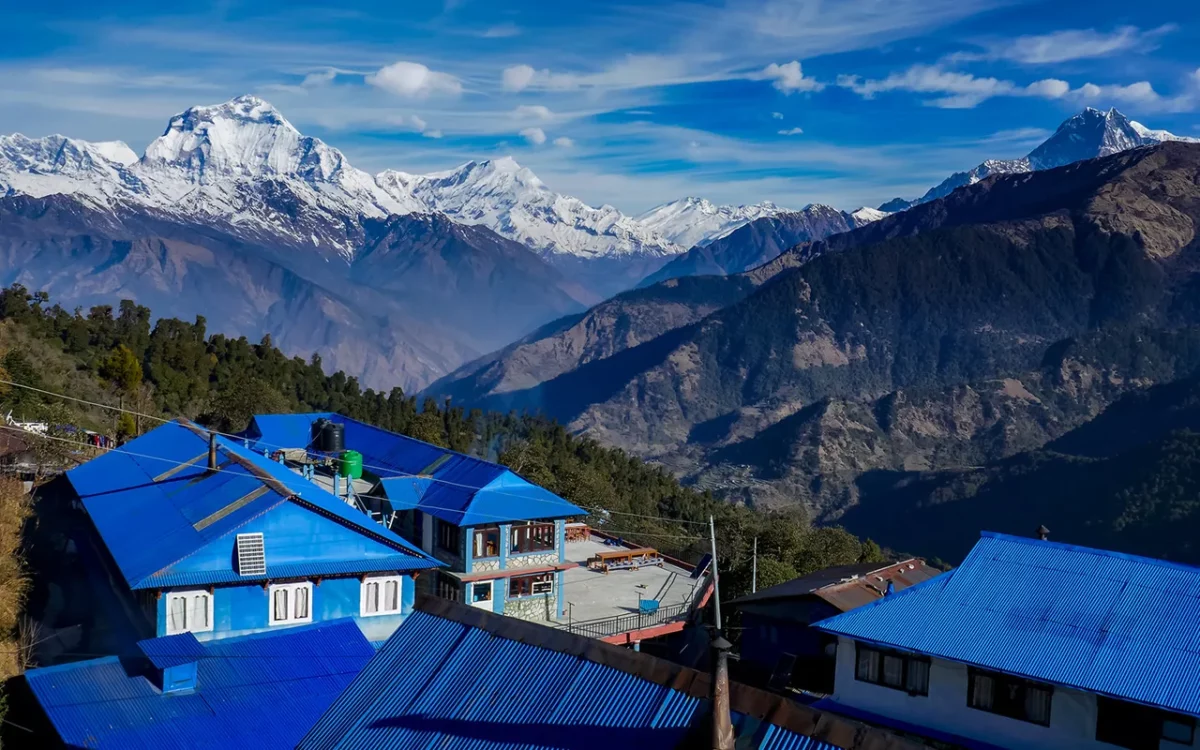
- Witnessing some of the TallestHimalayas around the world like Annapurna, Dhaulagiri, and Machapuchare.
- Leisure in Tatopani, releasing the tiredness.
- Witnessing the sunrise from PoonHill.
Trip Overview of Annapurna Base Camp Trek
The 14 daysAnnapurna Base Camp Trekking is like stepping into a world where each step moves you to a different climatic and geographical zone. Your adventure will begin at low and warm, subtropical lands. Moving along you cross the exquisite rice paddies, subtropical woodlands, and rural agrarian sceneries.
The landscape changes to high alpine meadow terrain as you gain altitude. It moves on and up through the steep and often snow-covered zones when you reach the Thorong La Pass at 5316m/17,449ft.
It’s a complete circumnavigation of the Annapurna Massif, covering diverse landscapes across five different districts, Lamjung District, Manang District, Mustang District, Myagdi District, and Kaski District.
Along the trail, you also have glimpses of great mountains. There are Mt Dhaulagiri (8167m), Mt Annapurna I (8091m), Mt Manaslu (8163m), and others such as Annapurna II (7937m), Annapurna III (7555m), Annapurna IV (7525m), and Annapurna south (7219m).
It does not end there, you will get the view of Nepal’s toughest Mountain, Mt. Nilgiri 7,041m, One and only Machhapuchhre 7,014m, Mt. Hiunchuli 6,441m, LamjungHimal 6,986m and the wowing Tilicho Peak 7,134m. It is a spectacular lineup of various Himalayas.
This is not merely a trek, it is an expedition through the widths and breadths of Nepal. A natural cupcake with sprinkles of culture on top.
Let me break the 14 days Annapurna Base Camp Trekking, beginning with the legacy, encroaching on the itinerary, combating the preparation, and much more.
Legacy of Mount Annapurna and Annapurna Base Camp Trek
According to Hindu Mythology, the term Annapurna was extracted from Sanskrit meaning Goddess of Harvests or Goddessof Full Food. Historically and religiously, the area is believed to be the abode of a deity providing food and nourishment to mankind, Annapurna.
Geographically and historically the Annapurna region acted as a salt trade routefor Nepal and Tibet. It did tackle many trades and not just salt too. At present, the hiking routes we traverse are the footprints of the traders back in the day. This allows us to immerse in the history and legacy of the way.
Since the Nepalese Government perfected the conflict of Khampa guerrillas in 1977, the Annapurna Base Camp Trek Route opened to trekking. It is today considered one of the most popular trekking route by people in the entire world.
Although it has its old trade roots, it only became popular after Maurice Herzog’s successfulclimb of the Annapurna I in 1950, marking the first-ever 8,000-meter peak to be ever submitted by a man.
Not only did Maurice Herzog’s accent make Annapurna recognized worldwide, but his climb also sparked an interest of people towards the Mountain.
The Annapurna Base Camp Trek path initially started from Dhumre, and it used to take approximately 23 days to finish, thanks to the southern part’s poor road network.
In recent days, due to the growth of the crowd at the Annapurna Base Camp Trek, the transport infrastructure has significantly improved. This allowed tourists to explore the prehistoric architecture of the one and only, Annapurna Base Camp Trek with ease.
(Note: The Trekking route development of the Annapurna Base Camp Trek was made without compromising its natural beauty and cultural integrity)
Itinerary of Annapurna Base Camp Trek
Day 01: Arrival in Kathmandu
When you get down at the Tribhuvan International Airport, our representative will be there to pick you up and take you to your hotel which is located in the busy city area of Kathmandu.
After putting your things away and having the chance to wash up, we will quickly go over some information regarding the trek, tips, and the overall 14 days Annapurna Base Camp Trekking. The rest of the afternoon is for you to decide. Recommendation is thelively and vibrant streets of Thamel.
You are also free for sightseeing at Kathmandu Valley world heritage sites like Swayambhunathand Pashupatinath Temple. Welcome Dinner eill be in the Evening at an authentic Nepali Restaurant with Nepali cultural shows.
Highest Altitude
1400m (Kathmandu)Day 02: Fly from Kathmandu to Pokhara
Today is a flight to Pokhara, the second largest city of Nepal which lies beside the Phewa Lake and is bordered by high mountains such as Annapurna, Manaslu, Macchapucchre, and Dhaulagiri.
Popularly referred to as the “Gateway to the Himalayas,” Pokhara is a fast-growing tourist city, especially for adventure travelers. There will be some time for sightseeing and for getting used to the conditions which will be crucial when we begin the real trekking to Annapurna Base Camp in Nepal, of course.
Highest Altitude
860m (Pokhara)Day 03: Drive to Nayapulthen Trek to Tikhedhunga
We start off with a morning drive from Pokhara to Nayapul which acts as the gateway of our trek. From here, we will start trekking to the Modi Khola accompanied by picturesque villages such as Birethanti.
The trail continues gently to Hilleand then ends at Tikhedhungaat 1540m, where we lodge. The trek offers astonishing sceneries and you get to witness theGurungand Magar tradition in their communities.
Highest Altitude
1540m (Tikhedhunga)Accommodation
HotelDay 04: Trek to Ghorepani
The next day, we will ascend across a small stream and climb the world’s famous 3,500 stone steps reaching Ulleri, a Magar village. The trail continues with a semi-steep rise with great views and after about an hour of steep rise the vegetation like rhododendrons and oaks can be seen.
Walking through a few charming villages including Nangethanti, we ascend to Ghorepani, a picturesque village famed for perfect Himalayan sights. We will stay the night here and early on will go for a hike to Poon Hill to catch the sunrise.
Highest Altitude
2870m (Ghorepani)Accommodation
HotelDay 05: Trek to Tadapani via Poon Hill
We will start early in the morning for a treasury trek to Poon Hill which will provide us with wonderful sunrise views of Annapurna and Dhaulagiri. Later in the day, after going down to Ghorepani for breakfast, the trekkers will be surrounded by Rhododendron flowers in forests, sprouting bright red, white, and pink.
The trail then goes down gradually towards Deuraliand Banthantiand then a little up to Tadapani, where we stay the night. This area presents great scenic beauty and diverse biodiversity, including wildlife like langur monkeys and deer.
Highest Altitude
2610m (Tadapani)Accommodation
HotelDay 06: Trek to Chhomrong
We come down from Tadapani with great views of beautiful and bright rhododendron forests and wonderful birds like Himalayan Monal and pheasants. The descent becomes easy as we approach Gurjung, a Gurung ethnic community village.
Moving along, we will reach Chhomrong, the beautiful village offering warm hospitality, and majestic Himalayas views of Annapurna South and Machhapuchhre. This is a good place to take a break, admire the scenery, and get ready for next-day hiking activities.
Highest Altitude
2150m (Chhomrong)Accommodation
HotelDay 07: Trek to Dovan
Today, we will drop down steeply to the ChhomrongKhola and then cross a suspension bridge. The trail then ascends steadily to Sinuwa Village at 2340 meters above sea level.
This then directs the hiker into another section which is a bamboo growth area, with shade and a bamboo lining that produces a soft sound of falling leaves. From the forest, we will move to Dovan, a small shire in a valley which we will use as our stopover for the night.
Highest Altitude
2600mAccommodation
LodgeDay 08: Trek to Deurali
Today we start our trek by moderate climb and then steep climbing as we near Deurali. On the way, we will go through the bamboo and rhododendrons flowers and can enjoy the dazzling Deuraliwaterfall where a stream of water pours down a rocky surface.
During our trek to Deurali, tourists will witness a splendid view of Hiunchuliand Machhapuchhremountains glowing in the golden sunlight during sunset. It makes for such a great area to meditate and take a break.
Highest Altitude
2960m (2,960)Accommodation
DeuraliDay 09: The Annapurna Base Camp Trek (ABC)
We’ll start walking through the river bank and slowly climb up to reach Machhapuchhre Base Camp (MBC) with a stunning view of the sunrise. After MBC, we trek to Annapurna Base Camp passing through abandoned shepherd huts and moraine fields.
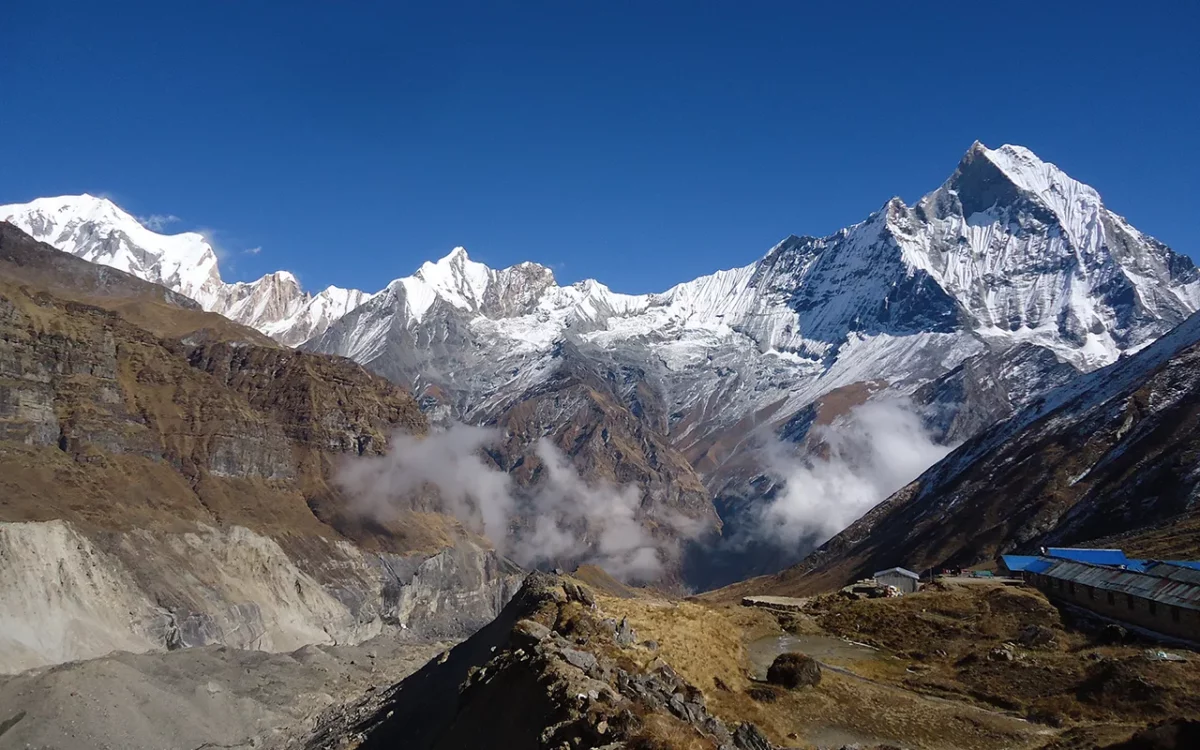
The destination where we will be reaching ABC is a wonderful natural amphitheater, surrounded by mountains, including Annapurna I and Machhapuchhre. It will leave a great and unforgettable moment.
Highest Altitude
4130m (Annapurna Base Camp Trek)Day 10: Trek to Bamboo
Upon arrival in the morning and a fantastic view of the mountains and surrounding area, we will start our descent. Moving backward through the moraine and dense forests, we have Bamboo, a small village of bamboo groves.
This descent provides an ideal opportunity to take a break and look at the surrounding beauty.
Highest Altitude
2340m (Bamboo)Accommodation
HotelDay 11: Trek to JhinuDanda
Starting today’s trek, we move up towards KhuldiGhar and go down to Sinuwa. In Chhomrong, we have our lunch and then steeply descend to JhinuDanda, popular for its natural hot spring. This descent provides an ideal opportunity to take a break and being surrounded by nature, it is the highlight of the trek that most trekkers seek to come.
Highest Altitude
1780m (JhinuDanda)Day 12: Trek to Nayapulthen Drive to Pokhara
The last stage of the trip lies along the Modi River, presenting the view of terraced fields and beautiful villages. Lunch will be at Landruk and then we proceed further to Nayapul.
Finally, we will drive for a little while and reach Pokhara where we will have a celebration of the trip’s accomplishment. Later, we can relax and relish the memories of the ABC trek.
Highest Altitude
860m (Pokhara)Day 13: Fly Back to Kathmandu
This morning we flew back to Kathmandu. There are beautiful routes to drive passing some of the richest landscapes one is able to see rivers, hilly terrains especially terraced hills, and culminating at traditional Nepalese villages.
We can go for a small flight which is scenic and can take shots from the skies of mountains like Macchapucchre and Annapurna which we ascended. On arrival at Kathmandu, we move to our hotel, and the rest of the day is spent on our own shopping, leisure, or visiting other places of tourist interest.
We will celebrate our completion of the trek in tge Evening with a cosyfarewell dinner.
Activity & Duration
dinnerHighest Altitude
1400m (Kathmandu)Accommodation
hotelDay 14: Departure from Kathmandu
Today we live the last moments of our exciting 14 daysAnnapurna Base Camp Trekking. After breakfast, the shopping time is left for wandering around the Thamelstreets, the most crowded part of Kathmandu.
Our team will also arrange a transfer to the airport from and you will at lasttake your departure flight home or to your next destination.
When departing, you will take with you an unforgettable trekking experience of theBhote Kang, Annapurna, and Dhaulagiri Himalayas, and our friendly Nepali community.
We hope that your trip is safe and we look forward to serving you again in Nepal for more trips.
Highest Altitude
1400m (Kathmandu)Essential Information of Annapurna Base Camp Trek
Food and Accommodation Options
The accommodation along the Annapurna Base Camp Trek route is simply teahouses. These teahouses are just family-run establishments providing very basic lodging, a bedroom with two singlebeds and a common shower and/or toilet.
There are improved services such as internet, warm water, and recharging of devices at a cost at lower altitudes. The higher the height the lower and price of the facilities because of the challenges involved in ferrying commodities up the hills. Even staying warm can be an issue, so sleeping bags are suggested to trekkers.
As for the meals, it’s general Himalayan trekking foods like dal bhat, pasta, vegetable curry, momo, fried, rice, and thukpa. Above all, the much preferred dal bhat is perfect to fill the hunger. The refills are also free in most of the places.
Food as well the lodging also tend to cost more with the elevation, what costs NPR 300 at lower altitudes may easily cost NPR 800 or more as it gets to altitudes like ThorongPhedi. So, sticking to basics is suggested for a budget-friendly trek.
Vegan options are also available so is a special diet, but you must consult with the agency about it prior to the trek. In this way, they organize and use it for you in advance.
Who Can and Cannot Do the Annapurna Base Camp Trek?
Annapurna base camp Trek is a generalist or versatile trek that invites all sorts of travelers. The trek involves covering 15 to 20 kilometers a day which includes steep drop-offs, and steep inclines in its trails.
You gain altitude rapidly. Climbing up to 5,416 at Thorong La Pass will challenge your internals due to its low oxygen allowance (about 50% less compared to sea level). That is why such a type of physical fitness is very important here.
Studies mention that people who have good cardiovascular fitness are more suitable for staying in high-altitude areas. Their bodies are more likely to function even with that small amount of oxygen.
The Annapurna Base Camp Trek can range anywhere from 10 to 21 days with eight or more hours of walking per day. That is why, Muscle strength and Endurance are also important factors to consider. A strong set of legs and core is a huge help in managing physical hardships.
So, Engaging in exercises like squats, lunges, and step-ups prior to a month of the Trek can enhance your capacity to handle the steep climbs and rough landscaping of the Annapurna region.
Hiking heights areas or just climbing uphill terrain with backpacks as a practice to imitate luggage will also help you tackle the actual trek.
Talking age-wise, the Annapurna Base Camp Trek is generally recommended for individuals between the ages of 16 to 65. But why this specific age range? Scientifically, it relates to the body’s ability to handle mostly the physical and also mental demands of high-altitude trekking and the potential risks that come with it.
Why the Age Range of 16 to 65?
Adequate Physical Maturity
Most young people have fully developed their physical capabilities at the age of 16 years with well-built muscles, hearts, and lungs. These features are vital for physical demands on the trek, especially at higher altitudes where the amount of oxygen is very low.
Journal of Applied Physiological (JAP) has showcased that young adults (aged 16 to 35) have better aerobic capabilities and cardiovascular health than other age groups, which allows them to adapt to the trek conditions efficiently.
Bone Density and Joint Health at Peak
For individuals around the age of 65, joint-associated health problems or bone fractures can be seen due to the bone density and joint cartilage gradually decreasing. However, by maintaining a healthy lifestyle, and exercising regularly, people in their 60s can still have strong bones and muscles.
Research conducted by the American Journal of Preventive Medicine has revealed that it is possible to prevent or at least delay the degrading bone density through regular exercises such as hiking as well as resistance training. This helps in strengthening bones and easing joint flexibility to avoid injuries.
Toughened Mentality
Mental strength is responsible for the age recommendation of trekkers as long hours of walking, basic rooms to stay and fluctuating weather conditions can’t be done by all ages. The youth possess better mental health and coping abilities, whereas the older people have acquired the health and experiences to undergo such ailments.
However, once one is above 65 years, the fact that cardiovascular fitness is relatively low, the recovery rate is slow and susceptibility to ailments in high altitudes is frequent, the risks are comparatively higher.
Why is Physical Fitness Necessary For Annapurna Base Camp Trek?
Annapurna Base Camp Trekking difficulty is moderate, including daily up and downhill distances, sharp ridges, narrow trails, and high passes over 5,000m like Thorong La. At this elevation, the oxygen level constitutes only about half of that at sea level, which even for a person of great fitness is quite demanding.
A healthy cardiovascular system can better deliver oxygen to all parts of the body thereby minimizing weariness or risk towards altitudes. Research from the Wilderness Medical Society opines that trekkers with aerobic fitness (measured by VO2 max), are likely to experience fewer cases of altitude sickness because their bodies are better acclimatized for handling low levels of oxygen.
For this reason, trekkers ought to be in their best cardiovascular health, muscle strength, and endurance, and these are considered to be in their prime between the ages of 16 and 65 years. Cardiovascular training by exercises such as running or cycling and also strength training workout is important to enhance the body functioning at high areas.
This doesn’t mean if you’re younger than 16 and older than 65, you automatically cannot climb this big boy, you surely can. Just make sure there’s no health constraint confining you, neither physically nor mentally.
Who Should Avoid This Trek?
Those with the risk of heart, lung, or respiratory problems should avoid the Annapurna Base Camp Trek, especially because the conditions such as Chronic Obstructive Pulmonary Disease (COPD), asthma, or heart disease worsen as altitude rises.
A study which was conducted in the New England Journal of Medicine has shown that people with these conditions can easily worsen AMS and also can worsen quickly if not treated early.
Pregnant women are usually discouraged from high-altitude hiking because of the dangers involved to both the mother as well as the unborn child. The International Society for Mountain Medicine suggests that low levels of oxygen cause harm to any developing fetus and there are increased risks of pregnancy complications that cannot be well controlled in areas of high altitude and in remote parts.
Thirdly, most of the patients with knee or back pain may be at risk of walking for long hours on rugged surfaces especially while descending. The effect on joints can be considerable and the probability of the twist such as ligament sprain or strain on rocky, unstable courses is elevated.
One should note that beginners to trekking or hiking should try out simple treks of lesser altitudes before trying out a strenuous one like the Trek to Annapurna Base Camp since the body has to be in good shape for higher altitude treks.
Preparation for the Annapurna Base Camp Trek | Essential Gear and Tips
Although the Annapurna Base Camp Trekking difficulty falls under the moderate level, there are various things to prepare for. The preparations for the ABC Trekking require proper gear items and physical fitness.
Pre-trek training is important, and you should start exercising at least 3 months ahead the actual trek. Engage in cardio, for at least 3 to 5 days a week with running, hiking, cycling, or swimming. Cardio prepares your lungs to take in more oxygen, useful when you are in high-altitude regions.
Moreover, strength exercises that target the legs and core muscles through activities such as lunges, squats, and deadlifts prepare the body for the capability of doing steep inclines and holding the intensity needed for long declines.
The choice of gear is an equally important aspect of preparing for the trek. The Annapurna Base Camp Trek weather can go from humid subtropical forest the lower altitude, to higher elevation, it is cold and windy.
Layering is key. Wear moisture-wicking base layers to keep the sweat away from the skin, warm mid-layers such as a fleece jacket, or down jacket for insulation, and a waterproof and windproof outer to protect from the snow and rain.
Sturdy hiking boots should be worn to avoid putting pressure on the ankle and blisters when walking on steep rocks. Make sure to pack it up so that your feet will not have any discomfort on the trail.
An important thing to have is a water purification system. The Annapurna Base CampTrek route is through remote villages like Tikhedhunga, Ghorepani, and Tadapani, and water from the taps in villages along the route may be unsafe to drink.
Having a water filter, purification tablets, or even a UV sterilizer like a SteriPENwill allow you to drink from the local water sources. This in a way ensures you do not have to spend your money on buying bottled water which is also a conservation-friendly practice.
Prescribed drugs should also not be forgotten in your packing list. You should pack pain relievers like ibuprofen, acetaminophen, and diamoxin case of altitude sickness and other personally prescribed medications.
One should include simple dressing with bandages, antiseptic wipes, blister pads, and anti-diarrheal tablets in the list of minimal supplies. These medications are a must because trekkers are prone to stomach upsets from unfamiliar food or water.
Altitude Sickness and The Precaution For It
Acute Mountain Sickness (AMS), Altitude Sickness is one of the major worries for climbers of the Annapurna Base Camp Trek, particularly above the Thorong La Pass. AMS is a condition that occurs when the body is unable to adjust in the reduced oxygen level when at a higher altitude.
The symptoms include headaches nausea, dizziness, breathlessness, and tiredness. If not taken care of, it can develop into high-altitude cerebral edemaor evendevelop intohigh-altitude pulmonary edema(HACE and HAPE) both of which can be fatal.
Proper acclimatization is necessary for safety purposes. This can be done by taking slow climbs where the body can easily adapt to the increasing altitudes.
A good rule to follow is “Climb High, Sleep Low’ which means one can ascend to higher grounds in the course of the day but descend to lower grounds during the night. Ensure you take a lot of water so that the body can be accustomed to the new environment.
Alcohol and smoking should be restricted because these are trigger factors that worsen the condition. Another medication that should also be carried is Diamox commonly used to tackle the elevations of AMS. It is advisable and important to always pay closer attention to the body. In case you experience signs of altitude sickness, go to lower altitude and rest.
They should self-evacuate or descend in case of progressive signs of the illness. We recommend taking rest days in such places as Manang, which is customary for most trekkers as a way to acclimatize to the high altitude and will greatly minimize your chances of illness.
Understanding the symptoms of sickness can be the difference between safe, fun trekking and having a disaster. Do not avoid rest days if your body is so sore, demanding for it to rest.
Why is Travel Insurance Essential On Annapurna Base Camp Trek?
It may seem unnecessary to spend money on comprehensive travel insurance for some people, however, it is advised for anyone who plans on trekking to Annapurna Base Camp in Nepal. The biggest reason to have insurance is the danger that comes with trekking in high mountains and secluded territory.
The main danger when goingfortheAnnapurna Base Camp Trek is when one experiences altitude sickness. This can develop suddenly once you reach a location of more than 3,000 meters above sea level.
Life-threatening conditions, like HACE or HAPE calls for an immediate descent and sometimes even helicopter rescues.
The cost of a helicopter rescue in the Annapurna Base Camp Trek Route can easily exceed $5,000, a huge financial burden if you’re uninsured. Whether or not you will get one out of nowhere is also not confirmed. With insurance, you are already backed with fast-track heli service in case of emergency.
Now, will you spend a penny for your very own safety in travel insurance, or spend a dime when trouble occurs to you is your decision to make. Travel insurance is beneficial as it provides safety and allows you to have a peaceful and financially secured trek.
The insurance policy isn’t only about covering medical issues either, we also get coverage for trip cancellations, delays, and interruptions with the itinerary.
For example, if the pass known as Thorong La closes due to a snowstorm or the flights from Jomsom are canceled due to a snowstorm, then you will be trapped with unexpected accommodation and transport costs.
Our travel insurance plan which covers up to 6,000 meters can cover your unexpected expenses in the Annapurna Base Camp Trek Route, ensuring that the trip doesn’t turn into a financial disaster.
Some of the risks that are likely to occur from the ABC Trekking are accidents related to its rugged surface.
We are aware that people get sprains, fractures, and minor injuries, especially on the sharp rocky terrains especially while descending from such areas as ThorongPhedi.
The trekker will have to seek medical attention as soon as possible but proper medical assistance can often be scarce. Our insurance entails medical evacuation, which means that in case you are in a hospital, you will get proper care and affordable treatments.
Finally, travel insurance provides the guarantee that one can have fun during the trek because you have someone else to ‘take care of the cost’ in case disasters strike. So, it is important that during your planning for 14 days Annapurna Base Camp Trekking, you consider acquiring the best travel insurance to cover your losses and protect your health.
Permits Needed Along The Way and Why
While undergoingAnnapurna Base Camp Trek in Nepal, you need two essential permits, the Annapurna Conservation Area Permit as well as theTrekkers’ Information Management System Card (TIMS and ACAP). These permits are very useful for legal, secure trekking, Annapurna conservation, and monitoring purposes as well.
The reason why there is a need to have the ACAP is because it provides funding to conservation projects that are meant to protect the special features of the area such as the conservation of ecosystems like red pandas, snow leopards and cultures of Gurungs and Magars.
The ACAP is required to enter Annapurna Conservation Area which is actually one of the biggest regions of conservation of natural life in Nepal.
Rich in biological diversity ranging from subtropical forests near Besisahar to the high-altitude desert of Muktinath, this natural wealth is protected by the funds collected from these permits.
The TIMS card is and must be crucial for safety tracking. Trekking authorities utilize it to register all of the various trekkers which is important as some of the trekkers might end up getting lost or perhaps get into an accident while trekking.
This is important in those remote areas such as Yak Kharka and ThorongPhedi where assistance could be a long way off. The card makes it possible to let the authorities know where you are in case you get lost or injured or in any other mishap.
This system has actually enhanced the safety of trekkers, such that rescue operations can be easily done and there is proper monitoring of traffic on the trails.
You don’t have to fret about the permits though, because they are in inclusionwith the package.
The only things you should not forget to take with you are your passport, passport-sized photos, and copies of your country’s citizenship cards. This document is sometimes required at several points on the route as you pass through Chame, Manang, or Jomsom and various other places.
Apart from legal requirements, these permits help manage sustainable tourism, benefit the people of Nepal, and ensure that the Annapurna region remains untouched and unspoiled by humans for the benefit of the next generations of tourists to the country.
Frequently Asked Question (FAQ’s)
The trek flora covers a little of all conceivable classes of plants. It supports various kinds of vegetation, forest, and alpine shrubbery. Wildlife found here consists of the Himalayan Pheasants, Langurs, and Snow Leopards (if you’re lucky enough)
Of courseits Autumn (September to November),then there isspring (March to May) too. These seasons feature good weather(clear skies and no fog) and a blossoming natural environment.
Well it’s Monsoon (June to August), forit invitesheavy rain, leeches and landslides. The winter season too, (December to February) is a no-go, especially after December 15, due to the freezing cold.
After the First Summit to Annapurna I in 1950, over 70 people have lost their lives to date.
A private helicopter rent comes at around $2,000 to $2,500 and a shared ride can cost between $300 to $600 per person.
Private Jeep tours range from $200 to $300 and shared tours cost approximately $20 to $50 for each traveller.
Annapurna Base Camp Trekking difficulty is labelled Moderately Challenging, as it doesn’t have difficulties that are impossible to tackle. It has its challenges of Distance, Altitude, Duration, and Terrain.
1. Bring water purification Tablets, as the higher you go the pricier stuffs get, even water.
2. Stick to basic Dal-Bhat, the reason being the same the higher you go, the pricier products get.
3. Opt to Off Season Trekking, as you get heavy discounts in these time frames.
4. Stick to a group trek. In that manner, the price of a guide is shared
5. Pack light, so that the porter fare is saved.
Trip Reviews on Annapurna Base Camp Trek
